Wall Art Hand: 3D Layered Design Review
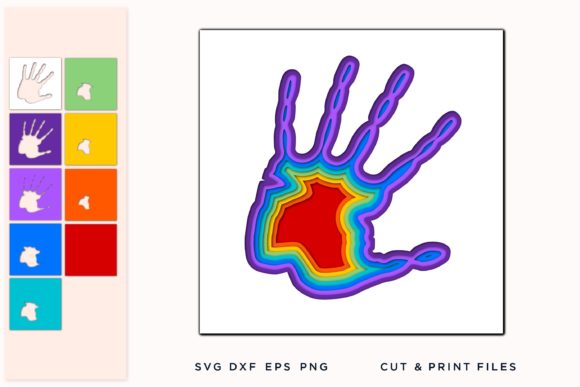
As a designer who spends more time behind an embroidery machine than a computer screen, I approach every new digital asset with a healthy dose of skepticism. When I first opened the files for the Wall Art Hand, 3D Layered Hand, my immediate thought was not about how it looks on a monitor, but how it will behave under the needle. This design is marketed as a 3D SVG intended for shadow boxes and layered paper projects, but as an embroidery professional, I see something different: a structural blueprint for dimensional textile art. The clean vector lines suggest precision, but translating a digital cut file into a stitched masterpiece requires understanding the interplay between fabric texture, stabilizer, and stitch density.
First Impressions: Structural Integrity vs. Visual Flow
The visual personality of this Wall Art Hand, 3D Layered Hand is distinctly modern yet organic. It avoids the overly intricate filigree that often plagues hand-themed designs, opting instead for bold, confident shapes that imply depth through layering rather than shading. For an embroidery designer, this is a relief. Complex gradients are difficult to replicate in thread without creating bulletproof patches of dense fill stitch. This design’s reliance on distinct layers means we can utilize fabric color and texture to create contrast, rather than relying solely on thread changes.
However, because this originates as a 3D SVG for shadow boxes, the "layers" are separate entities. In embroidery terms, this is essentially a multi-position applique design or a stacked felt project. The mood is tactile and sculptural. It feels less like a flat graphic and more like an architectural element. This makes it uniquely suited for projects where the viewer is expected to look closely and appreciate the craftsmanship, such as high-end nursery decor or boutique wall hangings, rather than quick-turnaround promotional items.
Real-World Application: The Custom Nursery Mobile Test
To truly evaluate this machine embroidery design, I mentally placed it into a recent client request: a custom sensory mobile for a high-end nursery. The client wanted something gender-neutral, textural, and safe. A standard flat embroidery would have looked cheap against the premium linen backdrop. Here, the Wall Art Hand, 3D Layered Hand shines as a component-based system.
In this scenario, I wouldn't stitch this directly onto the mobile arm. Instead, I would treat each layer of the hand as an individual embroidered patch. Using a heavy-weight water-soluble stabilizer or wool felt as a base, the design’s outlines serve as perfect guides for satin stitch borders. The separation of layers allows me to use different fabric textures for each segment—perhaps a waffle knit for the palm and smooth cotton sateen for the fingers. This transforms a digital file into a rich, mixed-media handmade product. For Etsy sellers specializing in baby embroidery, this approach adds significant perceived value. Customers aren't just buying a stitched hand; they are buying a complex assembly of materials that justifies a higher price point and distinguishes your shop from competitors using generic clipart.
Navigating Fabric Limitations and Hoop Constraints
While the design is versatile, its 3D nature demands respect for material physics. You cannot simply hoop a thin jersey knit t-shirt and expect this Wall Art Hand, 3D Layered Hand to perform without distortion. The multiple layers and potential alignment marks require absolute stability. If you attempt this on stretchy fabric without adequate support, the registration will fail, and your layered effect will look sloppy.
I strongly advise against using this specific design for curved surfaces like caps or the chest area of fitted apparel unless you are highly experienced with re-digitizing. The geometry is designed for flat, stacked assembly. For sweatshirt embroidery or tote bag designs, you must use a firm cut-away stabilizer, potentially doubled up, to prevent the weight of the multiple fabric layers from pulling the garment out of shape. Additionally, be wary of small hoop sizes. While the SVG is scalable, reducing it too much for a baby onesie might cause the internal details to merge during stitching. Always check the minimum viable size before committing to a production run. If the details disappear at 4x4 inches, keep this design reserved for larger formats like pillow covers or framed art.
Elevating Brand Value Through Technical Precision
For creative entrepreneurs and small shop owners, technical execution is synonymous with brand trust. A poorly executed layered design screams "amateur," while a crisp, well-aligned piece signals professionalism. The Wall Art Hand, 3D Layered Hand offers a unique opportunity to showcase technical mastery. Because the design relies on placement accuracy, your finished product becomes a testament to your machine's calibration and your hooping skills.
This level of detail impacts buyer engagement significantly. When listing this as a finished product, photograph the side profile to show the dimensionality. Flat photos do not do justice to a 3D concept. Highlighting the raised edges and fabric contrasts in your product photography validates the complexity of the work. For those selling digital embroidery files derived from this concept, providing clear instructions on stabilizer choice and layer order is non-negotiable. Your customers’ success with the design directly correlates to their trust in your future releases.
Critical Designer Notes Before You Stitch
Before loading this embroidery file into your machine, please adhere to these practical checkpoints to ensure commercial-grade results:
- Verify File Compatibility: This product is listed as an instant digital download containing SVG, DWG, and EPS formats. These are primarily vector cutting formats. Confirm whether your embroidery software can auto-digitize these vectors or if you need to manually trace them. Do not assume a .pes or .dst file is included unless explicitly stated in the full file list.
- Test on Scrap Material First: Never run a new layered design on your final product first. Create a test swatch using the exact fabric and stabilizer combination you intend to use. Check for gap issues between layers and verify that the satin stitch width adequately covers the raw edges of your applique fabric.
- Evaluate Thread Color Contrast: Since this design uses layering for depth, ensure your thread colors provide enough definition against your chosen fabrics. A dark thread on dark fabric will hide the beautiful structural lines. Test in black and white mockups to ensure the values read clearly.
- Check Licensing for Commercial Use: As an Etsy seller or craft business owner, always review the specific license terms included in your download. Confirm whether you are permitted to sell finished physical products, digital derivatives, or both. Protecting your business starts with respecting intellectual property.
- Stabilizer Strategy: For the 3D effect, consider using tear-away stabilizer between fabric layers to add permanent loft, or use fusible web to bond layers before stitching to prevent shifting. The right stabilizer is the difference between a flat stitch-out and a true 3D textile sculpture.
- Mockup Realism: If creating printable mockups for pre-sales, avoid placing this design on perfectly flat digital templates. Use textured backgrounds or angled views to represent the dimensional nature of the Wall Art Hand accurately. Misleading mockups lead to returns and negative reviews.
Ultimately, the Wall Art Hand, 3D Layered Hand is a sophisticated asset for the maker who understands that embroidery is construction, not just decoration. It bridges the gap between digital crafting and traditional textile arts. By treating it as a structural guide rather than a simple picture, you can create personalized gifts and commercial products that possess genuine artistic weight. Just remember: in the world of 3D embroidery, patience in preparation yields perfection in the final stitch.